
India sells the world best tea, spices, rice, seafood, and processed foods by the billions. So why does the UK, a market hungry for exactly these products, barely notice India on its import shelves?
That question sits at the heart of the India-UK Comprehensive Economic and Trade Agreement (CETA), which entered into force on July 15, 2026. It’s being called one of India’s most comprehensive trade deals to date, covering twelve major service sectors and a wide range of industrial goods. The government’s headline pitch is striking: duty-free access for over 95% of India’s agricultural and processed-food products into a UK agri-food import market worth more than USD 63.4 billion.
Agri-food exports already stood at USD 49.43 billion in 2024-25, roughly 11.2% of India’s total exports, so the UK opportunity is sizeable even relative to India’s existing export base. But for agriculture and food processing, which together make up nearly a quarter of all agreed tariff lines, the real story isn’t about the deal itself. It’s about what happens after the tariffs come down.
Here’s a closer look at the gap CETA is trying to close, the competitors already ahead of India in the race, and the policy tools that will decide whether this agreement becomes a genuine export breakthrough or just another headline.
Also Read: National Mission on Edible Oils
The UK-India Trade Gap Before CETA
Before CETA, Indian agri-food exporters were competing in the UK with one hand tied behind their backs and the numbers make it obvious.
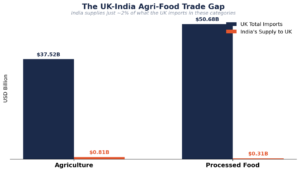
- The UK imports roughly USD 37.52 billion in agricultural products every year. India’s share of that? Just USD 811 million, about 2.2% of the market.
- In processed foods, the gap widens further. India exports USD 14.07 billion worth of processed food globally, yet manages only USD 309.5 million in UK sales, against a UK processed-food import bill of USD 50.68 billion.
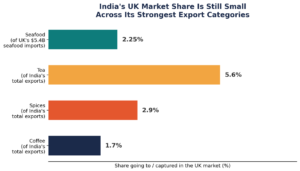
- India supplies just 2.25% of the UK’s USD 5.4 billion seafood import market, despite ranking among the world’s top seafood exporters.
- Even in categories where India is a global heavyweight, UK demand tells a different story: the UK takes only 5.6% of India’s tea exports, 2.9% of its spice exports, and 1.7% of its coffee exports.
We can say ‘India has the production capacity. It just hasn’t had the access.’
Why India Was Losing Before the Deal?
Three forces were working against Indian exports in the UK market and none of them were about product quality.
1. Tariffs Favored the Competition
Before CETA, Indian goods generally faced the UK’s standard non-preferential tariffs, while competitors with existing free trade agreements got duty-free or discounted access. That’s a direct hit to price competitiveness.
Take seafood for example, Indian shrimp, tuna, fishmeal, and feed faced UK tariffs of up to 8.5%, while Vietnam, a major shrimp and tuna competitor, sailed in duty-free under the UK-Vietnam FTA.
2. Established Rivals Had the Home-Field Advantage
In processed fruits, vegetables, and pickles, Indian exporters go up against Thailand, Spain, Italy, and Egypt. European suppliers benefit from shorter supply chains and the UK-EU trading relationship; Thailand brings decades of agro-processing infrastructure to the table.
Even in rice, where India dominates the premium Basmati segment, the picture gets murkier in non-Basmati and value-added cereal products, where Vietnam, Cambodia, and Thailand all compete under their own preferential terms.
3. Tariffs Are Only Half the Battle
Here’s the part that gets missed in most CETA headlines: An FTA removes tariffs it- doesn’t remove regulations.
Indian exports of spices, rice, groundnuts, sesame, fruits, and vegetables still have to clear UK sanitary and phytosanitary (SPS) rules, maximum residue limits (MRLs), traceability standards, and certification requirements. UK food-safety authorities have flagged Indian shipments in the past over pesticide residues, aflatoxins, and Salmonella risk, issues that trigger extra testing and compliance costs regardless of what the tariff schedule says.
The Takeaway: Tariff Access and Market Access are not the same thing.
Does India Already Have the Tools to Close the Gap?
This is the part that should make Indian exporters and policymakers optimistic. India isn’t starting from zero. It already has a policy toolkit built for exactly these constraints, even if most of it wasn’t originally designed with CETA in mind.
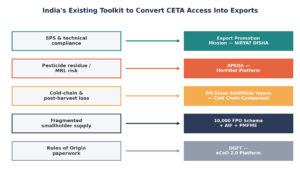
- SPS & technical compliance: Export Promotion Mission’s NIRYAT DISHA offers testing, certification, and audit support. Though it’s newly launched, and usage data isn’t public yet.
- Pesticide residue / MRL risk (grapes, fruits, vegetables): APEDA’s HortiNet links farm registration, monitoring, lab testing, and certification, if farmers and exporters adopt it.
- Cold-chain & post-harvest loss: PM Kisan SAMPADA Yojana’s Cold Chain component funds pre-cooling, storage, grading, and refrigerated transport.
- Fragmented smallholder supply: The 10,000 FPO scheme, Agriculture Infrastructure Fund, and PMFME support aggregation, credit-linked infrastructure, and processing capacity.
- Rules of Origin paperwork: DGFT’s eCoO 2.0 digitises Certificate of Origin issuance, but doesn’t loosen CETA’s substantive origin thresholds for processed foods using imported ingredients.
The Wildcard Nobody’s Pricing In: Shipping Costs
There’s one more variable that could quietly undo CETA’s tariff advantage, and it has nothing to do with trade policy: SHIPPING.
Ongoing disruptions around the Strait of Hormuz and the Red Sea have been pushing up freight costs and lengthening voyage times on routes that matter directly to India-UK agri trade.
If a tariff cut saves an exporter a few percentage points on landed cost, but freight and insurance premiums eat into that same margin, the net competitive gain shrinks fast, especially for perishable and mid-value categories like fruits, vegetables, and seafood, where timing and cost sensitivity are already tight.
This is worth watching closely over the next few quarters: CETA controls the tariff side of the equation, but it has no influence over the shipping side. Exporters and policymakers evaluating “CETA success” purely through export volume numbers should factor in freight cost trends as a real, independent variable.
Also Read- ‘Agri-Diplomacy: How Food Exports Are Shaping India’s Global Influence ?‘
Will CETA Actually Deliver 50% Export Growth?
CETA does what trade agreements are supposed to do: it removes a major cost disadvantage and puts Indian exporters at an advantage with Vietnam, Thailand, and EU suppliers in the UK market.
But tariff relief is the opportunity, not the outcome. Whether India actually captures that projected 50% jump in agricultural exports comes down to something far less glamorous than a trade signing ceremony: ‘execution’.
Can HortiNet actually get farmers certified at scale? Can FPOs move from “aggregation” to genuine export readiness? Can cold-chain infrastructure reach the last mile fast enough to matter? And can Indian exporters absorb global shipping volatility without losing the pricing edge CETA just gave them? These are the questions that will determine whether CETA becomes a turning point for Indian agri-exports or just an agreement that looked better on paper than in the numbers.
The opportunity is real. The infrastructure exists. Now it’s about integration, delivery, and staying resilient to costs outside India’s control, not just tariff lines.
Have thoughts on how India can better convert trade agreements into real export growth? Share your take in the comments below.