
Agri-diplomacy is the use of agriculture and food exports as tools of foreign policy to promote national interests and enhance international relations. In the modern interdependent world, food has ceased to be a trade commodity and has become a tool of geopolitical power. For India, a country where agriculture is a vital sector of the economy and provides livelihood to millions of people, food exports are a means to achieve economic and diplomatic ends. Through its increased agricultural trade, India has established itself not only as a large agricultural exporter but also as a major player in the provision of global food security. This enables India to leverage its agricultural power to gain global influence.
India’s Agricultural Export Profile
The strength of India’s agricultural exports lies in its production capacity and diversity. India is the second-largest producer of rice, wheat, and other cereals in the world, which provides a strong base for cereal exports. The increasing demand for cereals in the global market has created a positive setting for Indian agricultural exports in the international market. In 2008, India imposed a ban on the export of rice and wheat to secure the country’s food security and manage the rising prices. However, due to the country’s surplus production and the increasing demand in the global market, the ban was eventually lifted, although the exports are still restricted to a certain extent to meet the domestic and international demands. Indian cereals such as rice, wheat, maize, barley, and millets are well-known in the global market for their quality, making them highly competitive in the international market.
The agricultural prowess of India is not limited to cereals. Because of the varied climate, India has been able to provide a variety of fresh fruits and vegetables to the world. India is the second-largest producer of fruits and vegetables in the world after China. According to the National Horticulture Database (2023-24), the country has been able to produce 112.1 million metric tons of fruits and 209.39 million metric tons of vegetables, with 7.15 million hectares of land dedicated to fruit production. Animal products are also a major socio-economic contributor. India is the largest producer of milk in the world, accounting for 24% of total milk production in the world in 2022. It also accounts for 7.25% of total egg production in the world and has the largest number of milch animals in the world, including buffaloes, goats, and sheep.
The food processing industry further adds to the export value, dealing with fruits, vegetables, spices, dairy products, meat products, fisheries, grains, and processed foods. Since the economic liberalization of the country in 1991, foreign investment has been steadily increasing, with FDI in the food processing industry estimated at ₹5,037 crores (USD 608 million) in 2023-24. Further, cash crops such as cashew, introduced by the Portuguese in the 16th century, and groundnut add to the export base of the country. In 2022, India was the second-largest exporter of cashews in the world, thus establishing the importance of agricultural diversity in contributing to economic development and agri-diplomacy.
Export of Top 10 Agricultural Commodities
| S.No | Commodity | Apr-Mar2023 | Apr-Mar2024 | %Growth |
| 1 | MARINE PRODUCTS | 8,077.98 | 7,372.00 | -8.74 |
| 2 | RICE -BASMOTI | 4787.65 | 5843.30 | 22.05 |
| 3 | RICE (OTHER THAN BASMOTI) | 6356.71 | 4573.41 | -28.05 |
| 4 | SPICES | 3785.36 | 4248.56 | 12.24 |
| 5 | BUFFALO MEAT | 3193.69 | 3743.26 | 17.21 |
| 6 | SUGAR | 5770.83 | 2824.74 | -51.05 |
| 7 | OIL MEALS | 1601.72 | 1713.98 | 7.01 |
| 8 | MISC PROCESSED ITEMS | 1421.64 | 1653.35 | 16.30 |
| 9 | COFFEE | 1146.18 | 1286.28 | 12.22 |
| 10 | FRESH FRUITS | 864.62 | 1146.60 | 32.61 |
Diplomatic and Strategic Impact
The export of food products has a profound effect on increasing the influence of India in the international arena in several ways. First, it helps to improve the diplomatic relations between countries by promoting trust and cooperation. Countries that depend on Indian food exports are likely to maintain good relations with India. Second, it helps to increase the soft power of India. The popularity of Indian cuisine in the international arena, which is promoted by the export of basmati rice, spices, and traditional Indian grains like millets, helps to increase the influence of India in the international arena. Third, in times of international crises like pandemics, wars, or supply chain disruptions, countries that are reliable food exporters acquire strategic significance. The capacity of India to ensure the supply of food or to provide aid to other countries in times of international crises helps to improve its image as a responsible international actor. Additionally, it helps to maintain India’s leadership position in the emerging economies group.
Export Destinations
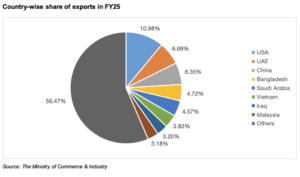
The major importing countries of agricultural products from India in FY25 were the United States, UAE, China, and Bangladesh. The United States became the leading importer of agricultural products from India, buying agricultural products worth US$ 5.62 billion, which accounted for close to 11% of India’s total agricultural exports. This indicates the increasing demand for Indian food products in the global market.
To further strengthen export growth, the Government of India has been actively promoting Indian agricultural and processed food products through virtual buyer-seller meets (V-BSMs). These online platforms connect Indian exporters with international buyers and help showcase products, especially those with Geographical Indication (GI) status. So far, 17 such virtual meets have been conducted with countries like Kuwait, Indonesia, Switzerland, Belgium, and Iran. Similar promotional initiatives have also been organized for Canada (focusing on organic products), the UAE and USA (highlighting GI products), as well as Germany, South Africa, Australia, Thailand, Oman, Bhutan, Azerbaijan, and Qatar.
In addition to these efforts, the government has established thirteen Agri-Cells in Indian embassies located in countries such as Vietnam, USA, Bangladesh, Nepal, UAE, Iran, Saudi Arabia, Malaysia, Indonesia, Singapore, China, Japan, and Argentina. These Agri-Cells provide real-time market information and support to enhance Indian exports by promoting trade, tourism, technology exchange, and investment opportunities in the agricultural sector.
Government Initiatives
- The Agriculture Export Policy (AEP) 2018) was introduced to expand India’s agricultural exports by diversifying both the product range and export destinations. It focuses on promoting high-value, indigenous, organic, traditional, and even non-traditional agricultural products. The policy also aims to create a strong institutional framework to improve market access and ensure that farmers directly benefit from opportunities in international markets.
- To support these goals, APEDA runs the Financial Assistance Scheme (FAS) for the period FY 2022–26. This scheme provides financial support for developing export infrastructure, improving product quality, and expanding market reach. The assistance ranges from ₹5 lakh to ₹5 crore, helping businesses strengthen their competitiveness in global markets.
- The Department of Commerce under the Ministry of Commerce & Industry also plays an active role in promoting exports through initiatives like the Trade Infrastructure for Export Scheme (TIES) and the Market Access Initiatives (MAI) Scheme. In addition, several export promotion boards such as APEDA, MPEDA, the Tobacco Board, Tea Board, Coffee Board, Rubber Board, and Spices Board offer guidance and support to agricultural exporters. To maintain quality standards and enhance credibility, India has made Nuclear Magnetic Resonance (NMR) testing compulsory for honey exported to the United States.